
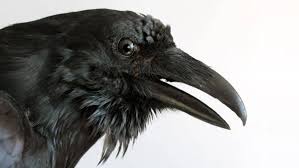
 Long ago, when the world was new, there was a bird that caused people much concern. This bird was as white as the falling snow, and very smart. But it was also mischievous, and loved to play tricks on people and other animals.
Some of the tricks were funny, and the people could laugh at the cleverness of the big, white bird. But there was one trick that was not funny at all.
Sometimes, when the people were preparing to hunt buffalo, the white bird would see this and would fly to the great herds and warn them of the people’s plans. The buffalo would run far away, and the people would be left hungry.
One day, with anger in his heart, a hunter set out to capture the white bird and to punish it for causing his people to go hungry. This was not an easy thing to do, for the bird was quite clever. But finally, after many days pursuit, he managed to trick the white bird into a trap. Ignoring its shrill cries, he hurled the mischievous creature into the flames of a fire.
The bird survived , but as it was flying away the hunter saw with satisfaction that its white feathers had been burned black, as black as the moonless sky.
And that, according to Sioux legend, is how the crow came to be.
Someone once remarked that if a person knows just three birds, one of those will invariably be the crow. And for good reason. The common, or American crow (Corvus brachyrhynchos) is the Seinfeld of our skies, an avian comic as oft-seen as it is widespread. We may never learn to recognize the song of the wood thrush, or the silhouette of the kestrel, but we sure as sassafras know who’s behind those rowdy and raucous “caws” that rake the air all day.

Whirling and twirling, flapping and flocking, these noisy neighbors – like politicians and parking meters – always seem to be around, no matter the season. Step outside, and there they are – twaddling in the trees, squawking in the schoolyards, gibbering like used car salesmen in city parks and country fields.
We know crows. Crows are…..common.
Something funny about those “common” things, though. More often than not they’re more intrinsically interesting, more gut-level wonderful, than the vagabond curiosities that rev up our wonder. Common things like starry skies and snowflakes, like sunflowers and music and the cat curled up in your lap.
Like Crows.
“If men had wings and bore black feathers”, Henry Ward Beecher observed, “few of them would be clever enough to be crows”. Now, you may not be accustomed to thinking of Corvus brachyrhynchos in such a reputable fashion. After all, probably no bird in the history of that feathered fraternity has been so robustly persecuted as the corn-loving crow.
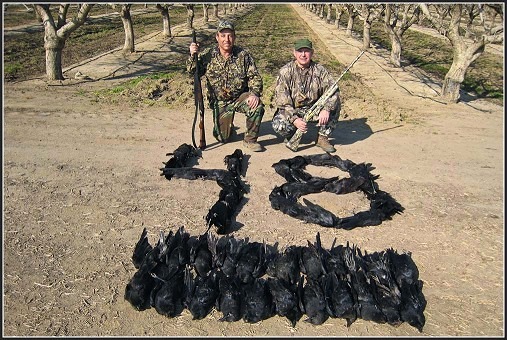
King Henry VIII slapped a public bounty its dusky head. Farmers in this country and abroad routinely shotgunned and dynamited the birds in their communal roosts, slaughtering hundreds as they slept. And the United States government, during the dark days of World War II, declared these “black bandits” an enemy of the American people, and urged their immediate destruction.
Even today, some rural communities stage annual “crow hunts”.
But the crow is a survivor, and it survives because it is smart. Probably no other bird on this planet – aside from the raven, the crow’s majestic cousin – is as intelligent as this loquacious scofflaw. It’s smart, and it’s fascinating, and it’s out there all year long.
We don’t know just how long crows have been out there, but we do know that it’s been a long, long time. These cosmopolitan covids, scientists tell us, have been filling the air with their frantic caws for at least 20 million years, or about 19,999 million years before Heckel and Jeckel ever wisecracked their way into American living rooms.

But there’s more to the crow’s vocal repertoire than caws. Cock an ear – the next time you find yourself near a treeful of crows, and count how many different sounds you actually hear. You might be surprised. The people who study such things report at least 23 distinct vocalizations in the crow vocabulary, from cackles and clucks to to screams, rattles, and coos. And this medley of sounds is not just idle chatter, either.
When crows talk, crows listen. And what they hear depends as much on the cadence and number of sounds as on the sounds themselves. Researchers have learned, for instance, that a few quick, sharp caws – well-spaced – means “be alert”, while the same caws close together are a dispersal call, and translate into something like “let’s get the heck out of here!”
Should a crow spot a lurking enemy – such as a large hawk or a great-horned owl – it might respond with a hoarse, drawn out “cawrr…cawrr…cawrr”. This is the assembly call, and it usually brings every crow in the vicinity flapping in for a fine mobbing. “Mobbing” is the crow’s method of dealing with a dangerous intruder. Typically, the birds will swarm all around the ominous visitor, shrieking and diving and growling (yes, I said growling) and generally making life unpleasant until the dangerous critter leaves.
There are other entries in the crow lexicon – a wailing “help me!” cry, a scolding cry, a mourning cry. Some researchers are even convinced that individual birds in a flock identify themselves while out foraging by the number and rapidity of their caws.
And crows are incorrigible mimics. Catherine Feher Elston, who wrote the book “Ravensong”, reported that Gagee, an injured crow she once cared for, became adept at imitating barking dogs, robins, music boxes, and even the tinkling of an ice cream truck.
Any bird with such an impressive vocabulary must have an impressive intellect as well, and stories of the crow’s savvy are legion. They have been taught to count to six and read a clock. They post sentries to warn a feeding flock of danger. They perch – a bit arrogantly, perhaps – on scarecrows. They will use a tool – a small twig, for instance – to scoop tasty insects from tree cavities. They drop clams and walnuts onto highways, letting passing cars crack open their dinners.
And, like any perspicacious critter, crows love to play.
A favorite game might be called Crow Rugby. One of the birds will snatch up a white pebble or piece of shell, then fly from tree to tree while the other crows give it an amiable bashing until it drops the “ball”. Crows love to startle sleeping rabbits by swooping down and rapping on their heads. They have also been know to tweak the tails of dozing dogs, pull at the ears of drowsy cows, and to hang upside down from wire perches – with just one foot.
Crows mate for life, and life for a crow can be 20 years or longer. They nest near the tops of coniferous trees (hence the term “crow’s nest” for those lofty shipboard lookouts), and unlike most birds their offspring will typically stick around to help the parents tend the hatchlings for three or four years before setting out to find their own mates. Crows will ear just about anything they can wrap their beaks around, including insects, earthworms, eggs, mice, berries, carrion – and, of course, corn.
Crows are indeed common, but they are also an intelligent, playful, sociable and intriguing dollop of wild nature in our otherwise urban lives. So the next time you see a flock of these remarkable birds winging o’er the horizon, or hear their rollicking caws in the air, stop a moment to look, and listen, and think.
To think how less wonderful our world might be…..if we did not share that world with the crow.

 Natural Wonders