

But Fred didn’t stay there long; Fred never stayed anywhere very long. With a deft felicity he rose into the air, darted about the room in expeditious zigs and zags, and finally settled on Sandy Koufax’s nose. For a moment. Then it was on to Babe Ruth’s glove, Hank Aaron’s groin, and the Uncle Scrooge comic book lying atop the cluttered crown of my old, four-drawer dresser.
Perhaps it was the idleness of the hour. Perhaps it was the way the lazy California sun came loafing through the window, or simply the vagaries of a boy’s fancy. It certainly wasn’t a lack of pets that compelled me to name a housefly Fred, and to keep it locked up in my room for nearly a week. But whatever the cause, I came and went like a cat burglar, carefully carefully slipping past my door lest Fred escape. It was comforting, somehow, to look up from a comic book or a reverie and see old Fred there, zipping hither and thither amongst the ballplayer photos I’d lovingly taped to my walls.
I don’t know what became of Fred. My mother left the door to my room open one day and that was that -Fred was history. But our relationship was never destined to be a long one; the average lifespan of a housefly is a scant three weeks. Yet every year, when both spring and flies again fill the air, I find myself thinking of old Fred. And for good reason: Those pesky flies – bane of picnic and pasture – are in reality remarkable creatures.

Take a close look at that fly the next time it lands on your sandwich at the outdoor cafe. The most important thing to notice – apart from which part of the sandwich to toss when the little beggar takes its leave – is the number of wings on its back. Of all major insect groups, flies (Diptera) are the only ones with a single pair of wings. The economy of design is really the secret behind the fly’s nimble artistry in the air. With fewer wings to balance and control, flies are free to live up to their name. The housefly (Musca domestica, in biospeak) beats its translucent wings at the phenomenal rate of 200 times a second. That familiar buzzing you hear when a fly is doing whirligigs around your head is actually the sound of its quick and quivering wings. All those wing beats propel it to an average flight speed of 4.5 miles per hour, although it can move considerably faster if prompted by a pursuing bird or a descending flyswatter.
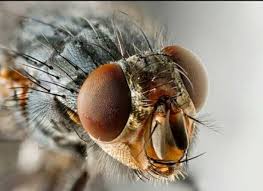
Now look at its eyes, those big, bulging eyes that leave room for little else on that tiny head. They’re illusions, you know. Like most insects, flies have compound eyes, which means that what seems to be two monstrous eyes are in fact thousands of eyes – 3,000 to 6,000 in each cluster – that each send a separate, blurry image to the fly’s brain. Blurry, because these simple eyes don’t really focus. But then, they don’t really need to. Flies aren’t interested in reading newsprint; if you are a fly, being able to spot the slightest movement can mean the difference between life and death, and there is nothing like a compound eye for spotting movement. And those gargoyle compound eyes give a fly a sensational range of vision, allowing it to see above, below, and to the sides as effectively as it sees straight ahead.
Bad news for anyone trying to sneak up on a fly.
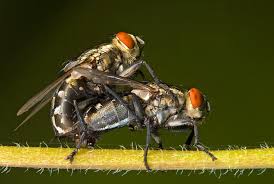
This ability to detect movement quickly also aids the fly in finding a mate. Because different insects have different wing speeds, which give off different light patterns, a male fly often finds a mate by following the distinctive light patterns made by a flying female fly. And if flies are adept at anything – besides flying – it is mating. And making new flies. The average female housefly lays between two and six batches of eggs in her brief life, with each batch containing 100 to 150 eggs. Someone once calculated that a single female fly, between the months of April and August, could – if all her female descendants and their descendants survived – have more than 190 quintillion offspring before embarking for that big garbage dump in the sky. Fortunately for the rest of us, though, this will never happen. That’s because the egg, larva, pupa, and adult stages of a fly’s growth all appear prominently on the menus of other creatures.
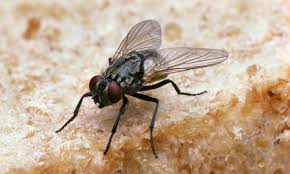
You may have noticed, when the fly landed on your sandwich, that it delicately ambled about before getting down to the business of eating. Well, there was cunning purpose behind that little stroll. The fly was actually “tasting” your sandwich with its feet, since the hairs on its six tarsi, or feet, react to chemicals in a substance the same way our own taste buds react to the flavors in food.
But using its eyes and its feet are not the only ways a housefly gathers information about the world it lives in. It can “smell” by using the two antennae that protrude from beneath its mouth (the antennae hairs are highly sensitive to odor-producing chemicals.) It can “feel” with its legs and thorax (the thick bristles respond to air currents and humidity). Finally, it can “listen” with its legs (certain leg bristles are sensitive to the movement of sound waves.)
Given their obnoxious prevalence in our lives and living space, it might seem that every fly out there is a housefly. But Musca domestica has lots of relatives in the Diptera universe. By the latest count, there are 152,000 named species of flies in the world, meaning that roughly ten percent of all species on this planet is some brand of fly. If that seems like a ridiculous amount of diversity, it is. But then, flies have had a long time to diversify.

Flies, it is thought (by those who think seriously about such things), first appeared on this earth in the Permian Period of the Paleozoic, or approximately 250 million years before today. They made their debut somewhere in a damp, soggy environment on the super continent of Pangaea. This means that there were flies buzzing about long before there were mammals, or birds, or flowers, or the peculiar allure of a burger and fries.
The housefly, Musca domestica, didn’t come along until about 50 million years ago, meaning it missed the entire Age of Dinosaurs. But it was here in plenty of time for the arrival of homo sapiens – a mere 200,000 years ago – and it has prospered ever since.
Chances are, houseflies aren’t going away anytime soon. So the next time you find yourself brushing away a fly, stop a moment and enjoy the extraordinary little varmint.
Who knows? You too may one day, someday find your very own Fred.

 Natural Wonders