
There was something growing in the yard.
The snail that was clinging to it knew what it was – it was an amorphous, dark glob in a world of light and dark globs.
The bee that paused to investigate knew what it was, too – it was a drab, colorless mosaic whorl, not nearly as provocative as the bright, yellow blossom blooming nearby.
The hawk that was circling hundreds of feet overhead knew what it was – it was a red something that could not be eaten and was of no practical value whatsoever.
The dog that trotted past also knew what it was – it was a gray, strong-smelling flower that its master liked to fuss over now and then.
And the woman that leaned over to inhale its sweet, ambrosial perfume certainly knew what it was – it was one of her prized red roses.

“A rose is a rose is a rose”, said Gertrude Stein, but that’s not quite true. What we see when we look out at the world depends mightily on the kind of eyes we look out with; a dog’s rose is not nearly so rosy as our own. And a snail would be a very uninspired choice as judge at the Garden Club’s annual rose competition.
Every eye, whether on cat or catbird, on lady or ladybug, serves a single purpose: to transform the light energy that floods our planet into information that can help the organism survive and flourish. A frog cannot see as far as an eagle, but it doesn’t really need to; in the frog’s view of things, a bug half a mile away is one very irrelevant bug. But a soaring eagle or hawk, whose eyes can see eight times farther than our own, must be able to spot that rabbit or rodent far below.

The eye may or may not be – as some poets have claimed – a window into the soul, but it is most certainly a window into the survival needs of its owner.
Broadly speaking, there are basically two kinds of visual organs in this world – single-lens eyes, and compound eyes. Anyone who has ever looked closely at a housefly’s face knows there are some pretty strange peepers out there. Those eerie, bubble-like bulges emblazoned with iridescent stripes are, in fact, a colony of eyes melded together, or – put another way – compound eyes.

All insects have compound eyes, and each individual “facet” of such eyes sends its own distinct information to the insect’s brain, blending into a mosaic of images whose acuity depends upon the owner’s needs.
If you were an insect and you were offering suggestions to the architect of eyes, the chances are good – whether predator or prey – that you would “focus” on two things: the need to see up close and personal, and the need to see movement. And there you have the genius of compound eyes.
Even primitive insects such as ladybugs – who have no more than nine or 10 facets in their eyes – can spot movement well enough to snare their share of aphids, while swift, darting fliers like the housefly, whose survival demands fairly intricate vision, has 18,000 facets in its eyes. Indeed, the dragonfly, whom the poet Tennyson called a “living flash of light”, has something like 30,000 facets in each eye. It can see no more than 10 yards distant, but within its visual range it sees every movement.

As an interpretive ranger with the National Park Service, I sometimes carried a nifty little toy in my pocket called a Dragonfly’s Eye. When you looked through it you would see what the world looked like through compound eyes. Flowers and trees and the Grand Canyon became a crystallized kaleidoscope of colors and fractured, elfin shapes. On nature walks I would talk a bit about how the non-human lives around us would see a very different world than we do, and challenge them to imagine what a pine tree or a rock or – for that matter – a person might look like to an insect. Most would try, but after a minute or so a shrug of the shoulders or a shake of the head would indicate that the task was hopeless.
“Maybe this will help”, I would cheerfully announce as I pulled out my Dragonfly’s Eye. Invariably, as the Eye was passed around, folks would react with wonder and delight as they gazed at the forest and, especially, at each other.
Compound eyes, though, do have their drawbacks.
For one thing, they cannot regulate the amount of light entering the eye, nor can they shift their focus from near to far. In fact, insects cannot see far at all.
To do that, you need something else. You need a single-lens eye.
Every vertebrate in the world – including you and I – has single-lens eyes, but the world those eyes reveal is as starkly different as the vertebrates themselves. And it is different because it needs to be different.
Consider the rose that I mentioned above, and then consider dogs.

A dog, with its keen sense of smell, doesn’t really need to see much color, and so the world it sees is mostly – like the title of the old Monkees’ song – “Shades of Gray”. As it happens, the retina of the eye has two primary types of cells: rods and cones. Rods detect light levels and motion, and cones detect colors. And dogs only evolved two types of cones, and so can only discern two colors: blue and yellow. That’s “dichromatic vision” in biospeak.
So when the dog saw the rose, the rose it saw was gray, not red.
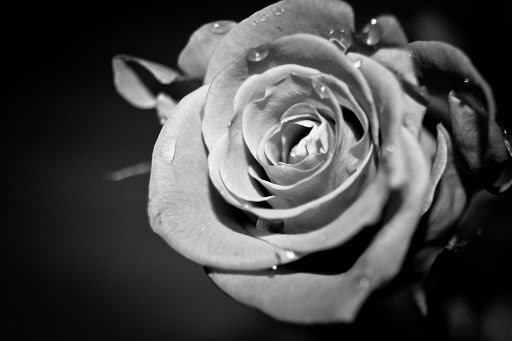
However, to vertebrates like the hawk and the woman, both of whom have relatively feeble sniffers, the rose they saw was indeed red. As with humans, it was in the survival interest of eagles and hawks to evolve excellent color vision, and they did. In spades. Science has discovered that eagles, hawks, and many other birds as well, can see further into the red range at one end of the color spectrum, and all the way into the ultraviolet range at the other. This means that the rose the hawk saw was, well, even rosier than what the woman saw.
Cats, though, are another story.
Suppose, for example – as unlikely as it may seem – that you and your cat are taking a stroll through a forest. You stop to admire the lustrous green foliage of a particularly lovely tree, but your cat seems unimpressed. You walk on together, probably farther than you should, and when you turn around the hour is already late.
Before you know it, it’s twilight time, and with head down your only interested in getting home before it’s dark. But now your cat is showing a lively interest in its surroundings, and wants to dawdle while you want to dash.
This is because cats, whose sense of smell is modest compared to a dog’s, do see color, but it is a bleached and washed out kind of color, and not terribly interesting. Their nocturnal eyes have a surfeit of rods but a scarcity of color-sensing cones, so their daylight vision suffers. But take that stroll at night and your cat’s eyes will gather five times as much light as your own. Like other nocturnally-adapted creatures, the cat doesn’t need to see color, but it does need to see well in the dark.
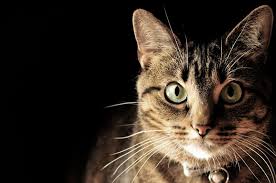
There were other animals in the forest besides you nd your feline friend. The deer you see resting in the shadows is also adapted for life in a dim world – in this case the twilit world of early morning and early evening. Like the cat, it dwells in a washed-out world during the bright hours of the day.
But the squirrel gamboling in that tree you stopped to admire can see the blue sky and the yellow flowers as vividly as you can. Red, though, becomes dark gray in the squirrel’s eyes, and when it gazes out at the forest it sees a forest of white leaves.
One of the silent assumptions we tote through life is that our view is the only view. But the frog you spot lounging on a log in the creek sees only blues and greens, so when the Muppet Kermit sings “It’s Not Easy Being Green…it could be nice being red, or yellow, or gold”, he’s dreaming of colors that – being a frog – he’s never actually seen. But then, frogs don’t actually sing, either.
And that cow grazing in that emerald pasture? Its eyes see only gray and black, and muted versions of yellow and blue. In its mind, the grass it nibbles all day is a dull, hazy gray.

Cows, like hares and horses and every other herbivore that needs a wide field of vision to spot approaching danger, have eyes on the sides of its head and what is called “monocular vision”. This means that each eye can be used independently of the other, which is great for range of vision but lousy for depth of field.
Cows would not be good at baseball.
Predators, for whom depth of field is critical, have eyes on the front of their head, giving them “binocular vision”.
But cats would not be good at baseball either.

The honeybee, and indeed all bees, cannot perceive the long, red waves of the spectrum, but they can see the ultra-violet rays hidden to us. To a bee, a red rose would simply look dark, but an apple tree full of white blossoms would look like a galaxy of bright, blue-green stars because the white flowers absorb UV light. And because flowers have evolved to attract bees -and many other insects as well – what seems to us to be a solid white or yellow flower will often be decorated with alluring designs that only a bee or butterfly can see.

* * * * * * *
There was something growing in the yard.
Many eyes saw it, but the eyes that gazed upon that rose, and what those eyes saw, was as different as the creatures themselves.
And though we’ll never fully know what the world looks like to a snail, or a dog, or a dragonfly, or any species that is not our own, we know enough to see, if only imperfectly, what a dazzlingly diverse world this is.
And that reality really is… in the eye of the beholder.
* * * * * *
Note To Readers:
Thanks for reading my article. If you enjoyed it, and would like to make sure you see future posts, here's how to do it:
1) first “like” the Natural Wonders page. (Just hit “like page” button below).
2) click on the small, gray box with three dots next to the blue message box.
3) click on “following”.
4) click on “edit notification settings”.
5) click on “standard”
This should guarantee that you see every new post. Otherwise, for whatever reason, Facebook sets the notification default to “highlights”, and you may not receive any notification at all.
 Natural Wonders