

We were sitting on the stone wall when the storm hit.
It wasn’t surprising. We had spent many hours sitting on that particular stone wall that particular summer. And when you spend the summer sitting on a wall in northern Arizona, smack in the middle of the Monsoon season, sooner or later you are going to get wet.
The four of us – Dov, Jeannie, Sharon, and I (along with supervisor Mac) – had been hired by the National Park Service, in partnership with the EPA, to conduct surveys on the public’s perception of changes in visibility at the Grand Canyon, and how important they considered good visibility to be.

It wasn’t hard work, and we could only work when there were people to be surveyed. So we sat on that stone wall at Powell Memorial and waited, and it was while we were waiting that the storm hit.
It came slowly, like the night.
In the distance, in the mountains above Flagstaff, we could see dark clouds forming. An ominous, celestial shadow that seemed to swell with the seconds, we watched as it crept across the cinder hills and sagebrush flats, watched as it crept past Red Butte and up the forested slopes of the Kaibab Plateau, watched as it subdued the sun and smothered the sky.
It erupted with a passionate fury.
I had experienced thunderstorms before, but this one was epochal. For 30 minutes or more it filled the air with a fusillade of liquid bullets, with deafening explosions and molten spears, and when it was over a dozen sudden waterfalls had burst into existence.
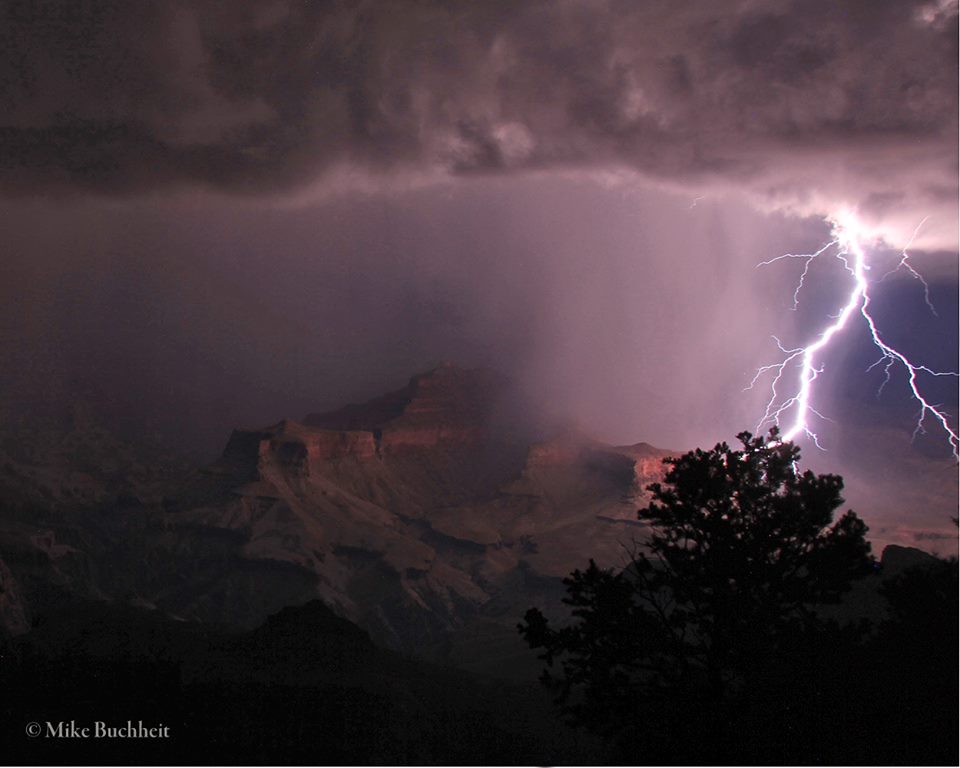
We walked over to nearby Hopi Point – that most celebrated of Canyon vistas – to admire these sudden falls, to watch water the color of liquified brick leap off the rim and plunge of feet to the slope below. The storm had washed part of the Bright Angel Trail into the river, but we didn’t know this yet.
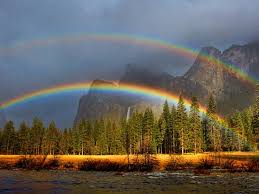
What we did know was that, in addition to the falls, there were two full and glorious arcs of radiant color glowing above a glorious canyon, and that the beauty was thunderous.
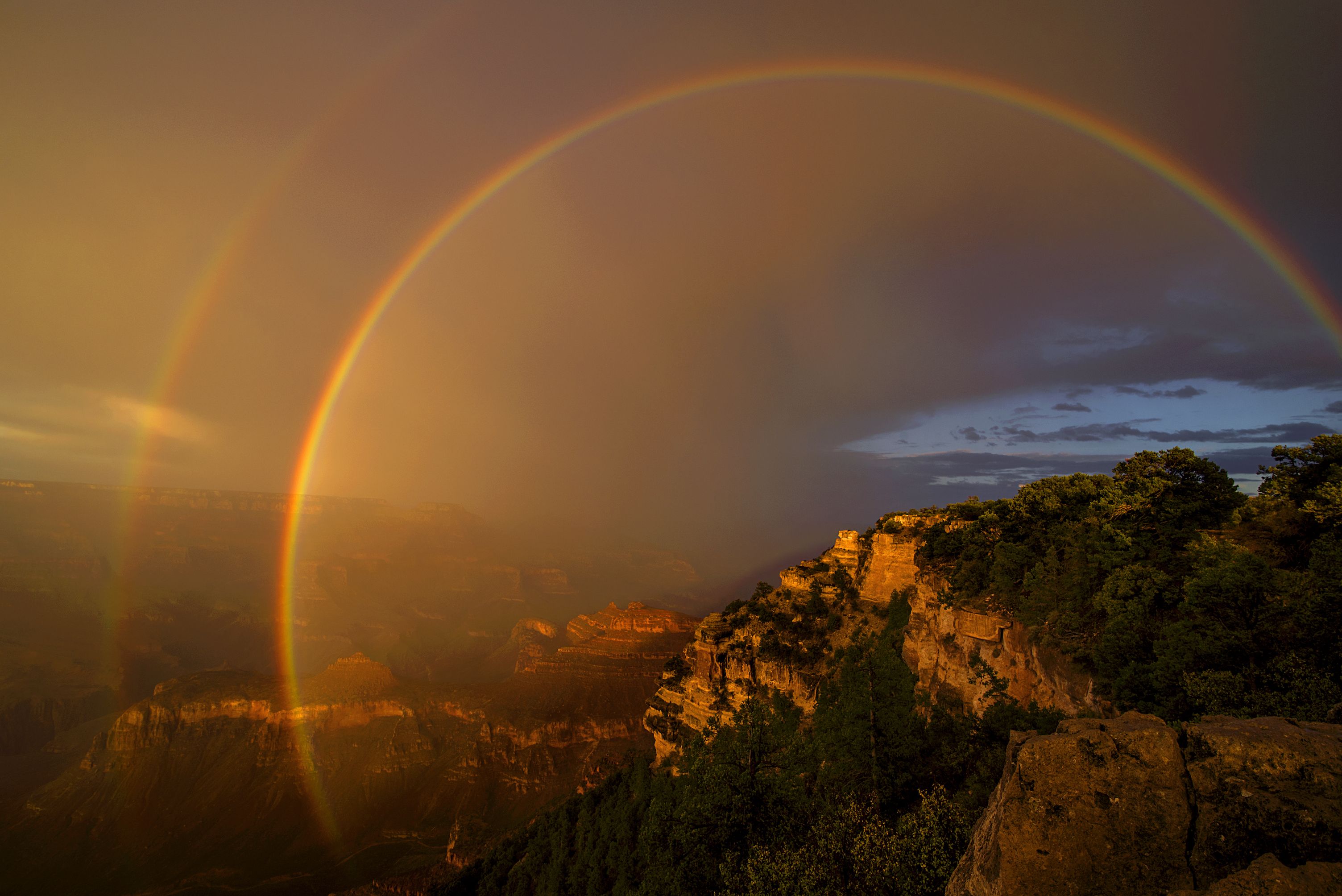
Rainbows. Who does not have at least one of these sky jewels tucked away in their jewel box of memories? Who has not discovered, along with the poet William Wordsworth, that “my heart leaps up when I behold a rainbow in the sky”? There is something intrinsically wonderful about these exquisite interludes between sun and storm.
These magical chimeras of luster and light.
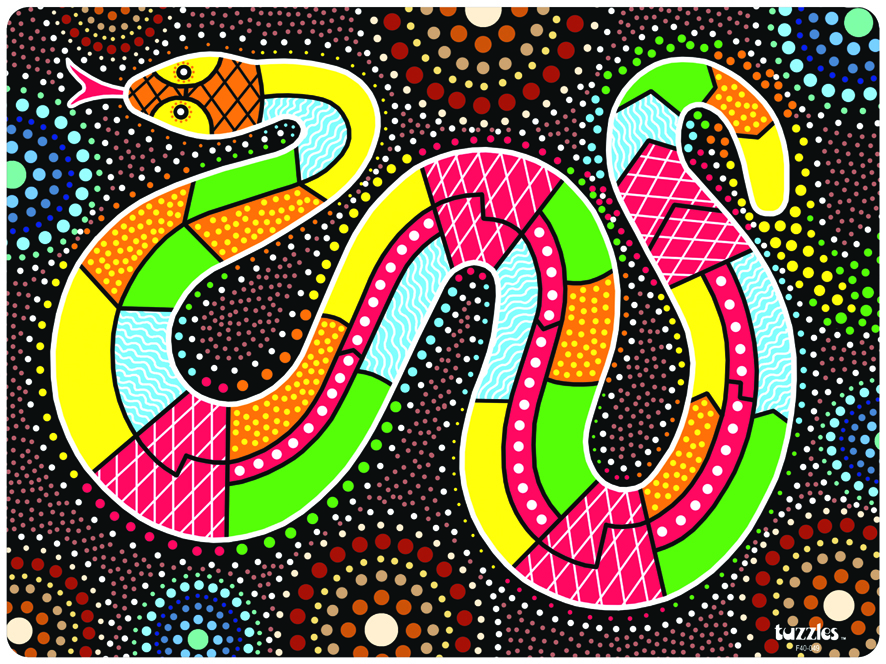
The mystery and wonder of rainbows have always shone brightly in our imaginations. In the Bible, in Genesis, God tells Noah that he has set a rainbow in the sky as a covenant, a kind of sticky note to Himself not to destroy all life on earth by flood. In Cherokee mythology, the rainbow is believed to form the hem of the sun’s coat. To Australian Aborigines, the rainbow is the Rainbow Serpent, the creator of the world and all beings.
A common “bridge” between many cultures is the belief that rainbows are a resplendent connection between the divine, or spirit world, and the earth. In Navajo tradition, rainbows are a symbol of protection and the pathway of the Yeis, the healing holy spirits that intercede between the Creator and humans, and control the sun, moon, wind, and rain. In the ancient beliefs of Japan, rainbows were the bridges that human ancestors took to descend to the planet. And in Norse legends, a burning rainbow bridge connects the earth with Vahalla, the home of the gods, and can only be used by the gods and those killed in battle.
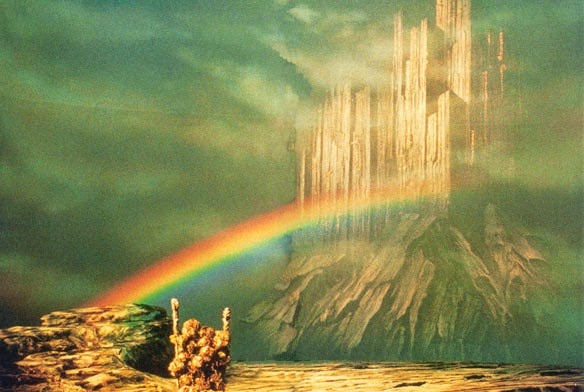
And don’t forget Dorothy Gale, who -stuck in the dreary flats of Kansas – dreamed that “Somewhere Over The Rainbow” was an enchanted land where “troubles melt like lemon drops” and dreams just might come true.
But what are rainbows, really? How do these fleeting arcs of fantasy seemingly materialize out of thin air?
To make a proper rainbow, we all know, you need rain, a fortuitous little fact that has kept writers of inspirational verse busy for centuries. But you also need light, light from a sun that is both behind the viewer and relatively low in the sky, which explains why a rainbow at midday is nearly as rare as a snowball in the Sahara.
For the secret of a rainbow is in a raindrop.

Long ago, in that faraway year of 1304, a German Dominican monk named Theodoric of Freiberg, had an insight. He was fascinated by rainbows, and he guessed that raindrops might hold the key to understanding these atmospheric marvels. Sunlight, after all, is white; rainbows most definitely are not. And rainbows only appear when it’s raining. What was it about rain, this curious monk wondered, that made these glorious bouquets of heavenly color possible?
Theodoric wanted to study the behavior of light as it passed through a raindrop, but how can you study something that plunges to the ground and is gone in an instant?
His answer was to build one. One that wouldn’t disappear. He had a glass globe blown to resemble a raindrop, filled it with water, positioned it so that sunlight would shine through it – and unlocked the secret of the rainbow.
What Theodoric discovered is that when the white light from the sun streams horizontally into a falling raindrop, that raindrop becomes a prism. The light is refracted, or bent, as it enters the raindrop, changing its angle. It is then reflected off the curved back of the water droplet and sent ricocheting right back into our eyes.
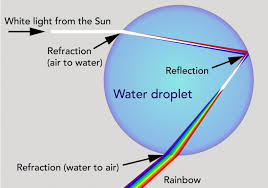
The monk found, when he moved back and forth behind his giant raindrop, that he could only see one color from any one angle, but that as he moved new colors appeared. He reasoned, correctly, that every color we see in a rainbow comes from a different set of drops, each reflecting one of the seven primary colors back towards the viewer.
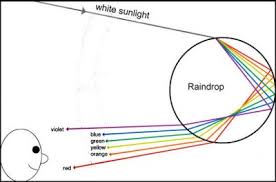
White light, after all, is really just a chorus of colors singing together, a fact that Issac Newton would conclusively demonstrate in his famous experiments with glass prisms in 1666. Bend it, as happens when the light is reflected from the back of raindrop, and the colors are isolated; that chorus becomes a solo. Exactly what color will be sent singing and shining back depends wholly on the angle of reflection.
Which, when you reflect upon it, explains why a rainbow is a fusion of seven distinct colors whose pattern never varies.
Rain, after all, does what it does best – it falls. And because the reflected color is determined by the angle of reflection, as it falls the light it reflects will first be red, then orange, then yellow, green, blue, and finally violet, falling through the spectrum as it falls through the sky. Like a motion picture, a rainbow is really an illusion, a spectral quilt crafted from moving water. This is why the top of a primary rainbow is always red, and the bottom is always violet.
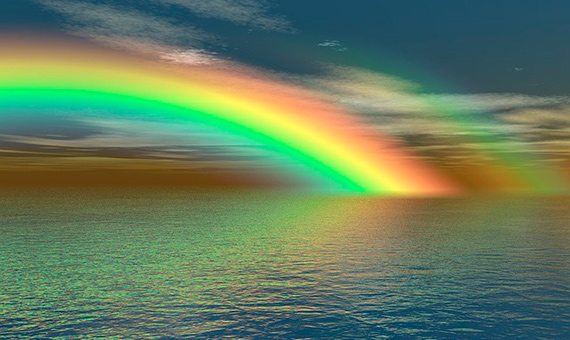
Notice that I said a primary rainbow. Probably the biggest thrill for a devoted rainbow watcher is to see a perfect double rainbow, as the four of us saw that soggy day at Hopi Point. A single rainbow is formed when light enters the top of a raindrop and is reflected once. A secondary rainbow, which is the outside bow of a double, is formed when sunlight enters through the bottom of a raindrop, is reflected two or three times, and finally exits through the top of the drop.
This is why the secondary bows are outside the primary and invariably fainter – the more light is reflected, the more it is weakened. And this is also why the pattern of colors is exactly reversed in a secondary rainbow; as it is ricocheting inside the raindrop, the light ray is reversed. Hence, secondary bows are mirror images of primary bows.
These are good things to know, and knowing them might deepen your enjoyment the next time you see a rainbow in the sky. But then again, it might not. For the very best thing about these fleeting bouquets of light is that they fade. For because they are fleeting we look, and because we look we remember, if only for a moment, what a beautiful world we call home.
And that’s the real pot of gold at rainbow’s end.
 Natural Wonders
I was waiting for another installment. This one met all expectations. Thanks!
Thanks, Terry😊 I’ve been more or less consumed with politicking this last month, working for positive change, (kinda like those Long Beach State days), but I finally managed to get something out. I’m happy you enjoyed it😊.